
Gutters and Roof Protection in Houston: How Overflow Causes Hidden Damage
In Houston, gutters are not just an accessory hanging off the edge of the roof. When they are present and functioning properly, they are part of the home’s water-management system. That matters even more in Southeast Texas, where the National Weather Service notes that March, April, and May are often the most active severe-weather season, bringing numerous showers and thunderstorms to the region.
When gutters clog, overflow, pull loose, or fail to receive water where they should, the damage is not always obvious right away. Homeowners usually notice the symptom late: peeling paint, a ceiling stain, soffit damage, rotted trim, or staining down a wall. By then, the water has often been misdirected through multiple storms.
What gutters actually do for a roof system
A gutter’s job is simple in theory: collect roof runoff at the eave and direct it safely into downspouts so the water leaves the roof edge in a controlled way. EPA’s Indoor airPLUS program treats gutters and downspouts as part of proper water management and calls for roof water to be directed away from the house, while related verification criteria also require gutters and downspouts to be securely installed and clear of debris.
That sounds basic, but the consequences are real when it goes wrong. Overflowing gutters can repeatedly wet fascia boards, soffits, siding, and wall assemblies. At roof-to-wall intersections, the problem is even more serious: Building America guidance explains that step flashing and kick-out flashing are needed to direct roof runoff into the gutter and prevent water from running behind the wall cladding.
Why gutter problems cause “roof” problems
A lot of homeowners think of gutters and roofs as separate issues. In practice, they overlap.
If water spills over the front of the gutter, backs up behind it, or misses the gutter entirely at a roof-to-wall intersection, that water can keep wetting the same vulnerable areas over and over:
roof edges
fascia and soffit
siding and trim
wall sheathing behind cladding
That is why some “roof leaks” are really drainage-detail failures. PNNL’s Building America resources specifically note that missing kick-out flashing can allow runoff to overflow the gutter and continuously wet the siding, leading to hidden water damage.
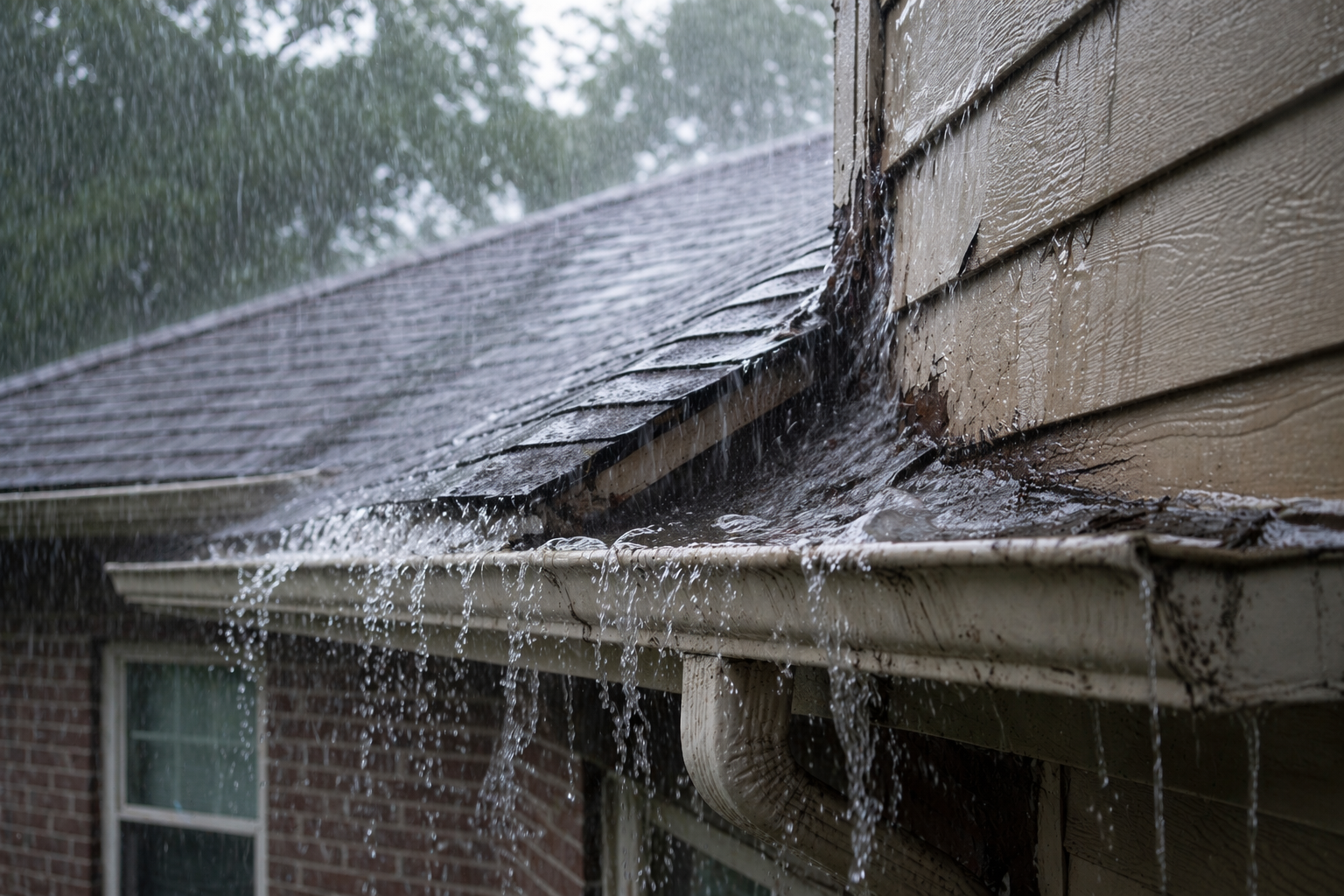
The hidden-damage scenario Houston homeowners miss
One of the most common hidden-damage patterns happens where a lower roof runs into a wall. Water comes down that roof plane, reaches the wall, and should be kicked out into the gutter. If the kick-out flashing is missing, too small, or poorly integrated, the gutter may technically be “there,” but the water still misses its intended path and runs behind the siding or stucco. Building America’s roof-wall flashing guidance says kick-out flashing should be installed at the end of a roof-wall intersection to divert water away from the wall and into the gutter, and notes that heavy rains can pour thousands of gallons of water onto a roof in a single storm.
That matters in Houston because repeated wetting is common during spring thunderstorms and tropical weather. Water entering behind cladding may not show up immediately inside the home. It can damage sheathing and trim first, then surface later as staining, softness, or moldy odor.
The most common gutter-related failure points
1) Clogged gutters and downspouts
Leaves, twigs, shingle granules, and roof debris restrict flow. FORTIFIED Home recommends checking and clearing gutters, downspouts, and drains so debris does not restrict proper flow, and NRCA similarly advises homeowners that basic maintenance can include cleaning gutters filled with dead leaves and debris.
2) Water running behind the gutter
This can happen when the gutter is loose, pitched incorrectly, overwhelmed by debris, or when the roof edge and flashing details are not working together correctly. The result is repeated wetting of fascia and soffit areas instead of controlled drainage away from the edge.
3) Missing or inadequate kick-out flashing
This is one of the biggest hidden-damage issues on residential homes. Building America and EPA-related water-management guidance both emphasize kick-out flashing at roof-to-wall intersections because the goal is to keep bulk roof runoff out of the wall assembly and direct it into the gutter.
4) Downspouts discharging too close to the house
Directing roof water away from the structure is part of standard moisture-management guidance. EPA Indoor airPLUS Version 2 calls for gutter systems to discharge at least 5 feet from the foundation, into an underground catchment system, or into other approved stormwater management paths.
Signs gutter problems are already causing damage
A gutter issue is not always obvious during dry weather. Some of the most useful warning signs are:
staining or peeling paint at fascia or soffit
dark streaks below roof-to-wall intersections
siding or trim that stays damp after storms
erosion or splash marks below downspouts
overflow visible during rain
mildew or musty smell near exterior walls or attic edges
Those signs do not automatically prove a roof failure. They often point to drainage problems, flashing issues, or runoff being directed to the wrong place.
What homeowners should check safely from the ground
A safe visual check can catch a lot before storm season:
look for gutters pulling away from the fascia
check for visible plant growth or debris in gutters
watch whether water shoots over the front edge during a storm
look at roof-to-wall intersections to see whether water appears to be running down the siding
check whether downspouts empty too close to the home
NRCA advises that most roof work should not be done by homeowners and that basic maintenance should be limited to safe inspection and gutter cleaning, staying off the roof when possible.
What a proper correction usually involves
The right fix depends on the cause.
If the issue is simple debris restriction, cleaning and confirming proper flow may solve it. If the issue is loose gutters, slope, or damaged downspouts, the correction is mechanical. But if water is missing the gutter at a roof-to-wall intersection, the real fix may involve flashing work, not just gutter work. Building America guidance is clear that step flashing and kick-out flashing must be integrated shingle-style and tied into the wall drainage plane so runoff is directed into the gutter instead of behind the wall cladding.
In other words: not every gutter overflow problem is “just a gutter problem.”
What not to do
Avoid these common mistakes:
replacing a section of gutter without checking the roof-to-wall flashing above it
smearing sealant where water is escaping instead of correcting the drainage path
assuming overflow only damages the gutter itself
ignoring repeated wall staining because “the gutter is still attached”
Water-management details work as a system. Fixing one visible symptom without finding the path of the water usually leads to repeat problems.
A practical Houston maintenance schedule
For Greater Houston homes, the most useful gutter and drainage routine is:
late winter / early spring: clear gutters and downspouts before spring storm season
after major wind events: remove fresh debris and inspect for pulled fasteners or sagging sections
before hurricane season: confirm water is being directed into gutters properly, especially at roof-to-wall intersections
after heavy rain: watch how the system actually performs during a storm
That last step is underrated. A gutter system can look fine in dry weather and still fail under real rainfall intensity. The NWS Houston/Galveston office regularly highlights locally heavy rainfall and storm-driven conditions in Southeast Texas, which is exactly when weak drainage details get exposed.
When to schedule an inspection
It is worth scheduling a professional roof/drainage inspection if:
gutters overflow during normal heavy rain
water appears to run behind the gutter
there is staining at roof-to-wall intersections
fascia or soffit shows softening, peeling, or repeated discoloration
a leak appears inside after wind-driven rain
the home has multiple roof-to-wall transitions and no obvious kick-out flashing
These are the situations where roof details, flashing, and gutter performance need to be looked at together instead of separately.
Ready for the next step?
Roof inspection / services:
https://communityroofingtexas.com/roofing-servicesFree online roof estimate:
https://communityroofingtexas.com/free-estimate
Community Roofing Texas helps Houston homeowners identify whether the problem is the gutter itself, the roof edge, or the flashing details above it—so the repair addresses the actual water path instead of just the symptom.