
Wind-Driven Rain Roof Leaks in Houston: Why They Happen and How to Prevent Them
In Greater Houston, not all roof leaks behave the same way. Some show up during long, steady rain. Others only appear during specific storms, often when wind is pushing rain hard against the house from one direction.
That second category is almost always wind-driven rain.
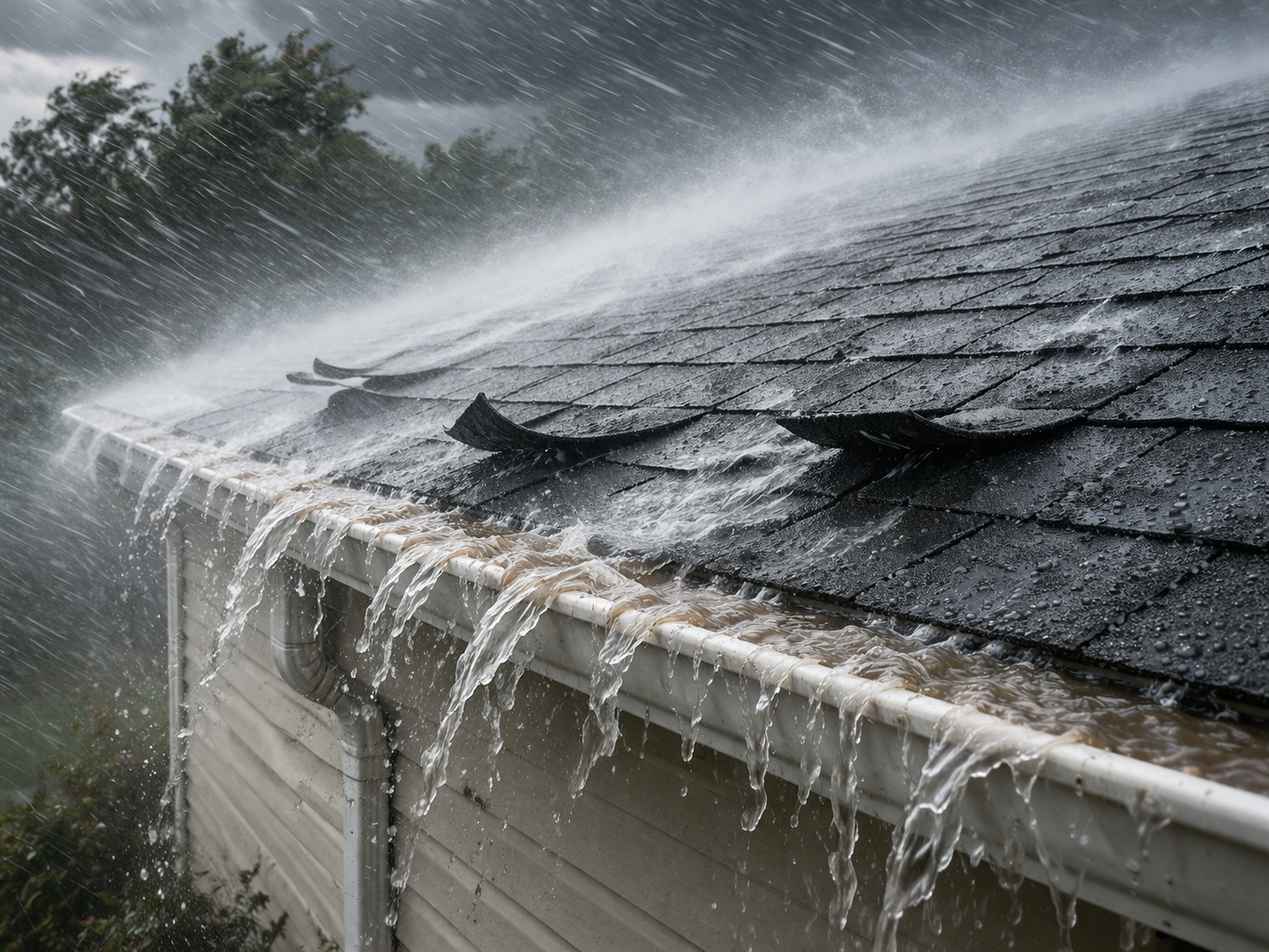
This type of leak doesn’t require a hole in the roof. It happens when wind pressure pushes water into small openings or weak details—especially at transitions, edges, and penetrations—where normal rainfall wouldn’t cause a problem.
Understanding how wind-driven rain works is the key to fixing it correctly and preventing it from coming back.
What is wind-driven rain (and why Houston roofs are vulnerable)?
Wind-driven rain occurs when rainfall is carried horizontally—or even upward—by wind, allowing water to:
bypass the normal “shed and drain” path of the roof,
enter tight gaps or seams,
and be forced under shingles or flashing edges.
Building science research consistently shows that water intrusion during storms is often driven by a combination of wind pressure + rain intensity, not just rainfall volume.
Houston is particularly vulnerable because:
storms frequently include strong gusts and shifting wind directions,
heavy rainfall can happen in short bursts,
and humidity keeps materials and assemblies from drying quickly once water gets in.
The #1 cause: roof-to-wall flashing problems
If a roof leaks only when wind hits from a certain direction, the first place to investigate is almost always a roof-to-wall intersection.
These areas rely on layered flashing details to redirect water back onto the roof surface:
step flashing (integrated with shingles),
counterflashing (where applicable),
siding or cladding transitions.
When these layers aren’t installed correctly—or have shifted over time—wind-driven rain can be pushed behind them.
Kickout flashing (a small detail with a big impact)
At the bottom of a roof-to-wall intersection, there should be a kickout flashing. Its job is to:
catch water coming down the wall,
and direct it into the gutter instead of behind the siding.
Without a proper kickout, water can run behind siding and enter the wall cavity—especially during wind-driven rain events.
This is one of the most common and most overlooked sources of leaks in Houston homes.
Penetrations: small openings, big problems
Roof penetrations are another high-risk category:
pipe boots
vent stacks
attic vents
skylights
mounted equipment
These areas combine:
movement (expansion/contraction, vibration),
multiple materials,
and concentrated water flow.
During wind-driven rain, water can be forced:
under a slightly lifted boot flange,
through a cracked seal,
or along fastener paths.
Even when everything looks “fine” from the ground, these details can fail under storm pressure.
Roof edges and terminations
Edges are where water exits the roof—and where wind can interfere with that process.
Common issues include:
loose or improperly integrated edge metal
gaps between shingles and drip edge
areas where wind can lift shingle edges
Once wind gets under the edge, it can:
break the seal between shingles,
allow water to move underneath,
and push moisture into the roof system.
Valleys and water concentration points
Valleys carry a high volume of water even in normal rain. In wind-driven rain, they can become even more vulnerable.
Problems occur when:
debris slows water flow,
flashing details are compromised,
or water is pushed sideways into shingle laps.
Because valleys concentrate flow, even small defects here can lead to noticeable leaks.
Why these leaks are often misdiagnosed
Wind-driven rain leaks are frequently misunderstood because:
they don’t happen during every storm,
they may only appear with certain wind directions,
and they often leave minimal visible exterior damage.
Homeowners may assume:
“the roof is fine most of the time,” or
“it must be condensation or something random.”
In reality, the pattern itself is the clue:
If a leak shows up only during wind-heavy storms, it’s almost always a detail issue—not a general roof failure.
What a proper inspection should focus on
A targeted inspection for wind-driven rain issues should include:
roof-to-wall flashing systems
kickout flashing presence and condition
penetrations (boots, vents, seals, fasteners)
edge details and shingle sealing
valleys and drainage paths
attic-side evidence (staining patterns that match wind direction)
The goal is not just to “find water.” It’s to identify where wind can override the normal water-shedding design.
What NOT to do when you suspect a wind-driven rain leak
These are common mistakes that often make the problem worse:
Applying random caulk or sealant
This can trap water or redirect it into new areas.Replacing shingles without addressing flashing
If the issue is at a transition, new shingles won’t fix it.Ignoring directional leak patterns
The wind direction is a diagnostic clue—don’t overlook it.
Proven ways to prevent wind-driven rain leaks
Prevention focuses on getting the details right:
Properly installed and integrated step flashing at walls
Correct kickout flashing at the base of wall intersections
Secure, well-sealed penetrations with appropriate materials
Clean, unobstructed valleys and drainage paths
Edge details that resist wind lift and water intrusion
These aren’t “upgrades”—they’re part of a properly functioning roof system.
What to do if your roof leaks during certain storms
Document the conditions
Note wind direction, storm intensity, and where the leak appears.Take photos if safe
Interior staining patterns can help trace the source.Avoid temporary patchwork fixes
These can complicate diagnosis.Get a condition-based inspection
Especially one that focuses on flashing and transition details.
If insurance is part of the conversation, start here:
https://communityroofingtexas.com/blog-1/dont-file-an-insurance-claim-after-a-storm-until-you-do-this-first
Ready for the next step?
Roof inspection / services: https://communityroofingtexas.com/roofing-services
Free online roof estimate: https://communityroofingtexas.com/free-estimate
Community Roofing Texas helps Houston homeowners identify and correct the real cause of storm-related leaks—so the fix actually holds up the next time the wind picks up.