
Hail Damage in Houston: What It Looks Like, What It Means, and What to Do Next
Hail Damage in Houston: What It Looks Like, What It Means, and What to Do Next
Hail can damage a roof in minutes, but the signs aren’t always obvious—especially on asphalt shingles. Some impacts cause clear granule loss and fractures. Others create “bruises” that are easier to feel than see. And sometimes what looks like hail is actually normal aging, foot traffic, manufacturing artifacts, or installation-related marks.
This guide explains the most reliable indicators of hail damage, how to avoid common misreads, and the right next steps for Houston-area homeowners after a hail event.
Start with the basics: hail size and why “severe” matters
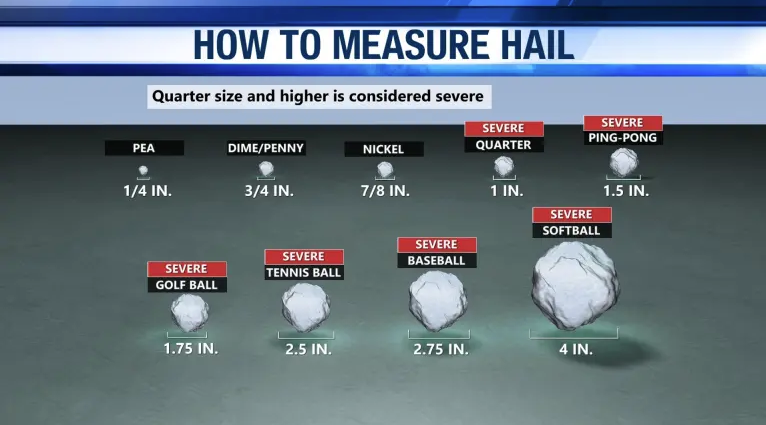
The National Weather Service provides widely used hail size references (pea, penny, quarter, golf ball, etc.) to help people estimate what fell.
A common National Weather Service rule of thumb is that quarter-size hail (1 inch) meets the hail threshold for a severe thunderstorm (criteria can be updated by NWS policy, but 1-inch hail is the widely communicated benchmark).
Why that matters for homeowners: larger hail increases the likelihood of functional roof damage, but smaller hail can still contribute to wear and localized damage, especially on vulnerable components (ridge caps, soft metals, exposed accessories).
What hail damage on asphalt shingles can look like
There are a few hallmark signs that repeatedly show up in roofing technical guidance.
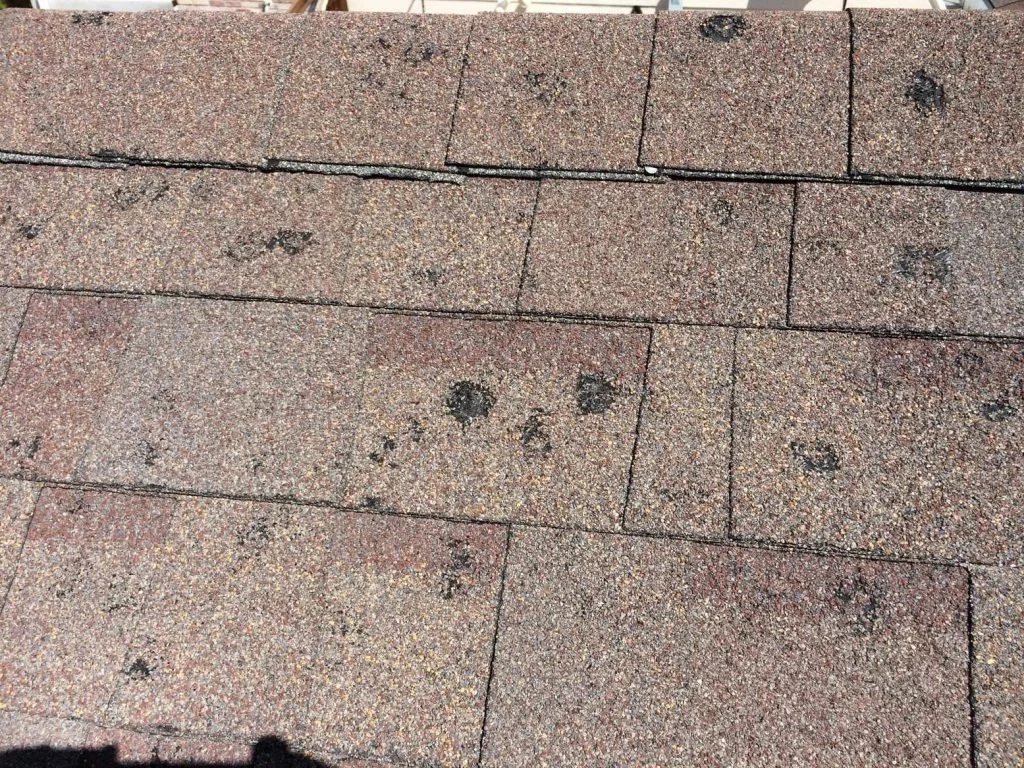
1) Localized granule loss at impact points (often with a depression)
Manufacturer technical bulletins describe hail-caused shingle damage patterns that include granule loss at impact points and surface depressions.
What it often looks like:
a roughly circular spot where granules are missing,
darker asphalt showing through,
sometimes a slight “dimple” at the center.
2) Cracking in the surfacing, sometimes radiating outward
Technical guidance also notes cracks in surfacing that may radiate from impact points.
What it often looks like:
a star-like pattern,
hairline cracks around a bruised area,
more visible in angled light.
3) Exposed fiberglass mat or fractured mat (not always immediately visible)
Some impacts can be more serious than they look. Manufacturer guidance describes cases where the fiberglass mat is exposed or fractured, and that mat fractures may be hidden at first and show up later as cracks or tears.
This is one reason roof assessments shouldn’t rely only on ground photos.
4) Spatter marks and “cleaned” spots on roof surfaces
NRCA guidance notes that hail can leave spatter marks—areas where grime/algae/oxidation appears cleaned off by hail impact.
Spatter isn’t the same thing as confirmed shingle functional damage, but it’s a useful clue that hail likely hit the roof surface.
The parts of a shingle roof that are most hail-vulnerable
IBHS emphasizes that ridge caps are among the most hail-vulnerable parts of a shingle roof system.
Other commonly vulnerable items include:
soft metal vents and flashings (dents can be a hail “witness mark”),
skylight components,
pipe boots and exposed accessories.
If there’s no evidence of hail impact on “witness” items, it doesn’t automatically rule out hail—but it should prompt a more careful, evidence-based assessment.
“Look-alikes”: damage that gets mistaken for hail
This is where homeowners (and plenty of contractors) can get led astray.
IBHS specifically warns about hail look-alikes, including general granule loss at shingle edges, mechanical marks, blisters, and other conditions that aren’t hail impacts.
A very common example: granules in gutters. Granules can accumulate for multiple reasons—normal early “rider granules,” aging/weathering, foot traffic, manufacturing characteristics, or storm impact depending on the pattern and context.
The takeaway: don’t diagnose hail damage based on a single “symptom.” The best assessments look for consistent, repeatable indicators across slopes and roof features.
Cosmetic vs functional hail damage (why the distinction matters)
Not all hail marks reduce service life. Insurance and roofing assessments often distinguish between:
Cosmetic damage (appearance changes without clear reduction of water-shedding performance), and
Functional damage (damage that compromises the shingle’s ability to protect the roof over time, such as mat fracture, significant granule loss exposing asphalt, or cracking that can propagate).
Manufacturer technical bulletins describe how storm-caused granule loss can expose asphalt to the environment and accelerate aging, and how hidden damage can manifest later.
Because this is a roof-system integrity question, a proper evaluation matters more than a quick glance.
The right homeowner response after a Houston hailstorm
Step 1: Document hail “witness” evidence immediately
From the ground and around the property, take photos of:
dented gutters/downspouts,
dented vent caps, soft metal flashings,
damaged window screens or outdoor AC fins (if visible),
hailstones (if safe to do so) next to a ruler/coin for size reference.
NWS hail-size charts are useful for estimating and describing hail in a consistent way.
Step 2: Avoid risky roof walking
Don’t climb onto the roof. It’s a fall hazard and can cause additional damage. A professional inspection is safer and more reliable.
Step 3: Get a condition-based inspection
NRCA homeowner guidance supports inspections—especially after severe storms—to identify damage and reduce the chance of small issues becoming larger failures.
A proper hail inspection should evaluate:
multiple slopes (hail often hits unevenly due to wind),
ridge caps,
flashings and penetrations,
“test areas” for consistent impact patterns,
attic-side evidence where safely accessible.
Step 4: Make insurance decisions based on facts, not pressure
A measured approach is best: document, inspect, then decide. For an insurance-first decision framework, link to:
https://communityroofingtexas.com/blog-1/dont-file-an-insurance-claim-after-a-storm-until-you-do-this-first
If replacing a roof is on the table: impact-resistant options (what “Class 4” means)
If a roof replacement is needed (for hail or overall condition), many Houston homeowners ask about impact resistance.
UL 2218 is a recognized impact test standard used for classifying impact resistance of roofing products (often referenced as “Class 4” for the highest rating in that standard). IBHS has published summaries and research comparing asphalt shingle impact resistance using UL 2218 as a baseline standard.
IBHS also maintains an impact resistance test protocol for asphalt shingles designed to replicate key physical aspects of natural hail under controlled conditions.
Important: an impact rating improves resilience, but it does not make a roof “hail-proof.” Hail varies in size, hardness, wind speed, and angle of impact.
Quick checklist: do these things after hail
Photograph dents/marks on soft metals and roof accessories
Save hail size reference evidence if available (photos with a ruler/coin)
Check gutters/downspouts for unusual granule piles and take photos
Check attic for new staining or damp insulation (if safely accessible)
Schedule a professional roof inspection to confirm condition
Ready for the simplest next step?
Inspection / roofing services: https://communityroofingtexas.com/roofing-services
Free online roof estimate: https://communityroofingtexas.com/free-estimate
Community Roofing Texas serves the Greater Houston area and provides clear, documented assessments after hail—so the next step is based on evidence, not assumptions.