
Why Early Roof Inspections Save Houston Homeowners Thousands Before Storm Season
Why Early Roof Inspections Save Houston Homeowners Thousands Before Storm Season

Greater Houston area roofs live in a tough environment: heat, humidity, sudden downpours, and wind-driven rain that can push water into weak points. The most expensive roofing problems usually don’t start as dramatic failures. They start as small defects—at a flashing seam, a pipe boot, a valley, or a roof edge—then storms and moisture turn them into larger repairs.
A well-timed roof inspection helps identify those early vulnerabilities before storm season stress tests the system.
Why timing matters in Greater Houston
“Early” means scheduling an inspection before storms are frequent and intense—so you have time to plan and fix problems under normal conditions.
For Greater Houston, strong inspection windows are:
Late winter to early spring (pre-spring storm ramp-up)
Late spring (before hurricane season peak risk)
After significant wind or hail events (especially if anything looks “different” afterward)
The National Roofing Contractors Association (NRCA) encourages homeowners to have roofs inspected regularly because issues like missing/damaged shingles, deteriorated flashings, and granule loss are easier to address before they create interior damage.
How early inspections reduce repair costs (without hype)
The cost of roof-related water damage depends mainly on how far moisture spreads and how many building materials are affected. When problems are caught early, repairs are often limited to a small area. When problems go undetected, moisture can affect additional components and require more extensive work.
Typical progression looks like this:
Early stage: localized repair at a flashing, penetration, or small shingle section
Middle stage: larger area of underlayment/shingles affected, possible decking repair, insulation replacement
Late stage: broader interior repairs (drywall, paint, trim), more decking replacement, and potentially professional moisture mitigation
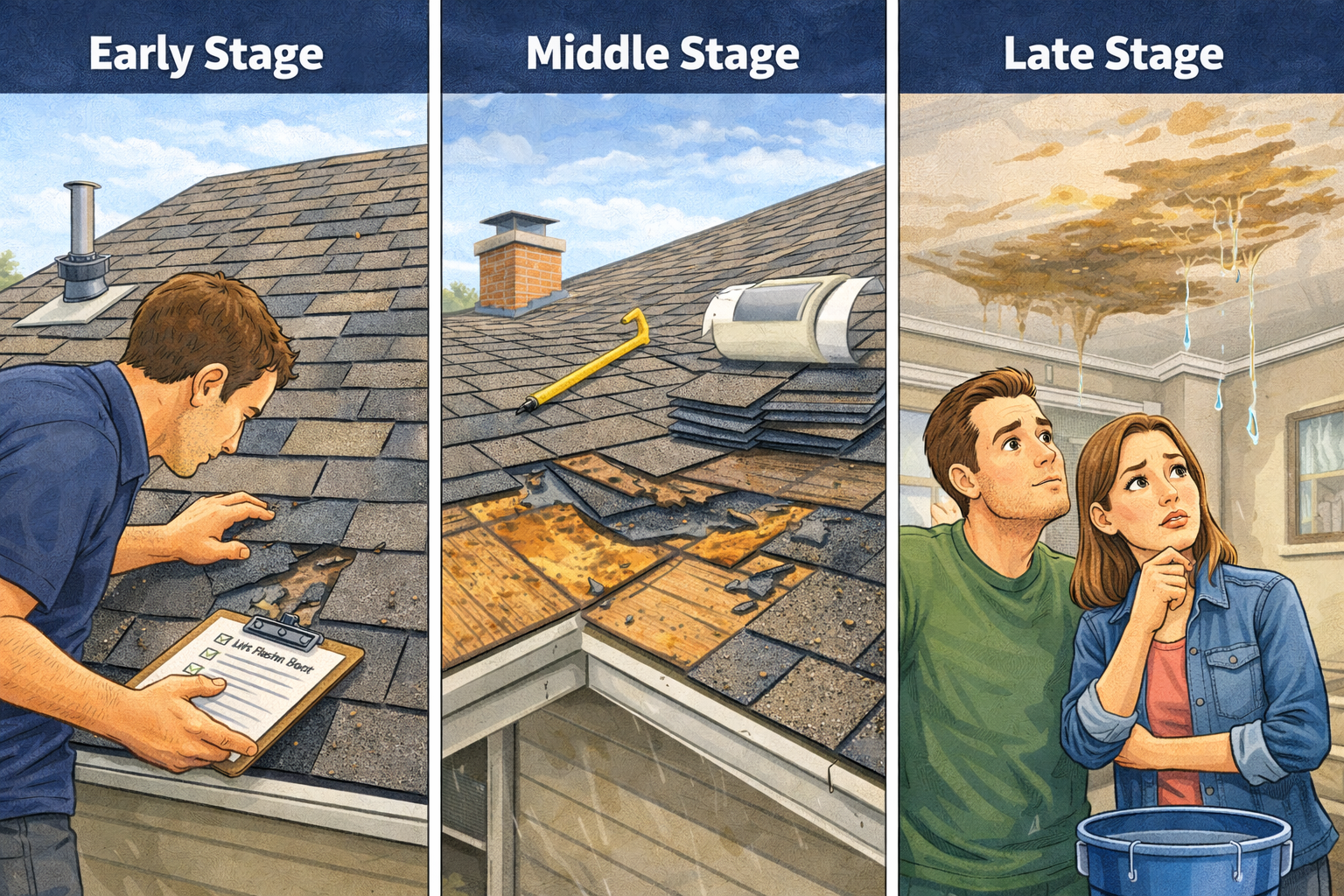
That’s why the goal isn’t just “finding damage”—it’s catching the first signs before the affected area expands.
That’s why the goal isn’t just “finding damage”—it’s catching the first signs before the affected area expands.
What a professional roof inspection should cover
A real roof inspection is not a quick glance from the driveway. It should evaluate the parts of the roof system most associated with leaks and storm failures:
1) Roof covering condition (shingles or metal)
The inspection should check for:
missing, cracked, torn, curled, or lifted shingles
ridge cap damage
visible fasteners where they shouldn’t be
excessive granule loss (often seen in gutters/downspouts)
NRCA notes that inspections can reveal common warning signs such as cracked/warped/missing shingles and excessive granules collecting in gutters and downspouts.
2) Flashings and roof transitions (the most common leak zones)
Flashings protect roof intersections and transitions, including:
roof-to-wall areas
chimneys
valleys
skylight transitions
edges and terminations
NRCA’s consumer guidance emphasizes the importance of properly installed, tight flashings around chimneys, vents, skylights, and wall intersections to prevent water entry.
3) Penetrations (pipe boots, vents, and anything that goes through the roof)
Penetrations are frequent leak sources because they combine:
water flow paths
movement over time
multiple material interfaces
Inspection should verify the condition of boots, collars, seals, and the surrounding shingle/flashing integration.
4) Drainage and water management (gutters, downspouts, flow paths)
Houston rain intensity makes drainage performance critical. Inspection should include:
gutter and downspout function
signs of overflow or water running behind gutters
valley debris dams
drainage paths that push water against vulnerable transitions
5) Attic-side evidence (when safely accessible)
Attics often show problems before ceilings do. A good inspection looks for:
staining on roof decking
damp or matted insulation
rust on fasteners or nail tips
musty odor or visible moisture patterns
Ventilation is part of roof/attic performance. Residential code provisions commonly set minimum attic ventilation requirements using a net free vent area ratio (often expressed as 1/150 with an exception allowing 1/300 under specific conditions).
Houston storm reality: wind-driven rain finds weak details
Many storm leaks don’t come from a dramatic “hole.” They come from small separations that wind-driven rain can exploit—especially at:
roof-to-wall intersections
valleys
pipe boots and vent penetrations
edges and terminations
That’s why inspections should focus on the details—not just the field of shingles.
A safe homeowner pre-check (no roof walking)
Before calling a pro, a quick ground-level check can help identify obvious red flags:
From the ground (binoculars help):
lifted or missing shingles
ridge cap distortion
visible flashing separation at walls/chimneys
debris piles in valleys
sagging gutters or overflow staining
Inside (attic if safely accessible):
new staining on decking
damp insulation
musty odor that wasn’t there before
If any of these are present, it’s worth getting a condition-based assessment before storm season accelerates the problem.
What to do if a storm hits and something looks wrong
Document what’s visible (photos from the ground are fine).
Avoid “quick patch” repairs that aren’t part of a proper flashing/roof detail—incorrect repairs can create new leak paths.
Get a professional assessment so next steps are based on facts.
If insurance is part of the conversation, this related guide is a helpful next read:
https://communityroofingtexas.com/blog-1/dont-file-an-insurance-claim-after-a-storm-until-you-do-this-first
Ready for the simplest next step?
Request a free online roof estimate: https://communityroofingtexas.com/free-estimate
Or explore inspection and roofing services: https://communityroofingtexas.com/roofing-services
Community Roofing Texas serves the Greater Houston area and helps homeowners get clear answers before storm season forces rushed decisions.