
How Houston Homeowners Can Prepare Their Roof for Spring Storms
How Houston Homeowners Can Prepare Their Roof for Spring Storms
In Southeast Texas, spring isn’t just “nice weather.” It’s often one of the most active severe-weather windows of the year—driven by warm, moist Gulf air colliding with stronger frontal systems. The National Weather Service Houston/Galveston office specifically notes that the spring months (March, April, and May) are commonly the most active severe-weather season for the region. (National Weather Service)

For homeowners, that matters because spring storms don’t typically fail roofs by “wearing them out.” They exploit weak points fast—especially at flashings, penetrations, and drainage paths—then wind-driven rain does the rest.
This guide is a practical, Houston-specific checklist to reduce leak risk before the next round of storms.
The 3 spring-storm forces Houston roofs need to handle
1) Wind-driven rain (not just rainfall)
Many leaks during storms are caused by rain being pushed sideways or upward into vulnerable transitions—roof-to-wall intersections, step flashing zones, and penetrations.
2) Hail and debris impact
Hail and wind-blown debris can damage shingle surfaces, dislodge components, or crack seals—sometimes without obvious “missing shingles.”
3) Short-duration, high-volume downpours
Houston downpours stress drainage. If water can’t move off the roof quickly, it can back up in valleys or overflow at edges, increasing the chance of intrusion where details are already borderline.
The roof prep rule that saves the most headaches
Don’t start with the middle of the roof. Start with the details.
Industry roof inspection guidance consistently focuses attention on the areas most vulnerable to distress and water entry—roof perimeters, flashings, penetrations, rooftop equipment, and drainage. (National Roofing Contractors Association)
And for homeowners specifically, NRCA recommends limiting DIY “maintenance” to safe actions like seasonal visual checks and cleaning gutters, because improper work can damage the roof or create safety hazards. (National Roofing Contractors Association)
Houston Spring Storm Roof Prep Checklist
Step 1: Do a safe ground-level walk-around (binoculars help)
Focus on these visible red flags:
lifted, curled, or missing shingles
ridge cap sections that look shifted or “puffed”
metal edging that looks loose or separated
flashing lines that look “shadowed” (often a sign something lifted)
debris piles sitting in valleys
If you can see something from the ground, it’s worth documenting. If you can’t see anything, that doesn’t mean you’re in the clear—many spring-storm leaks come from transitions you won’t see without a trained inspection.
Step 2: Prioritize penetrations (pipe boots, vents, skylights, mounts)
Penetrations are common leak sources because they combine:
water flow paths,
movement over time,
and material transitions.
Building-science guidance for existing roofs emphasizes inspecting and maintaining flashing and sealing around all penetrations to keep a continuous water-control layer. (Building America Solution Center)
What to look for (from the ground or attic-side where visible):
cracked rubber at pipe boots
lifted flanges
exposed fasteners where they shouldn’t be
sealant that’s split or missing (where sealant is part of the detail)
Step 3: Clear and test drainage (gutters + downspouts)
In Houston, gutters are not cosmetic—they’re part of the roof’s water-management system.
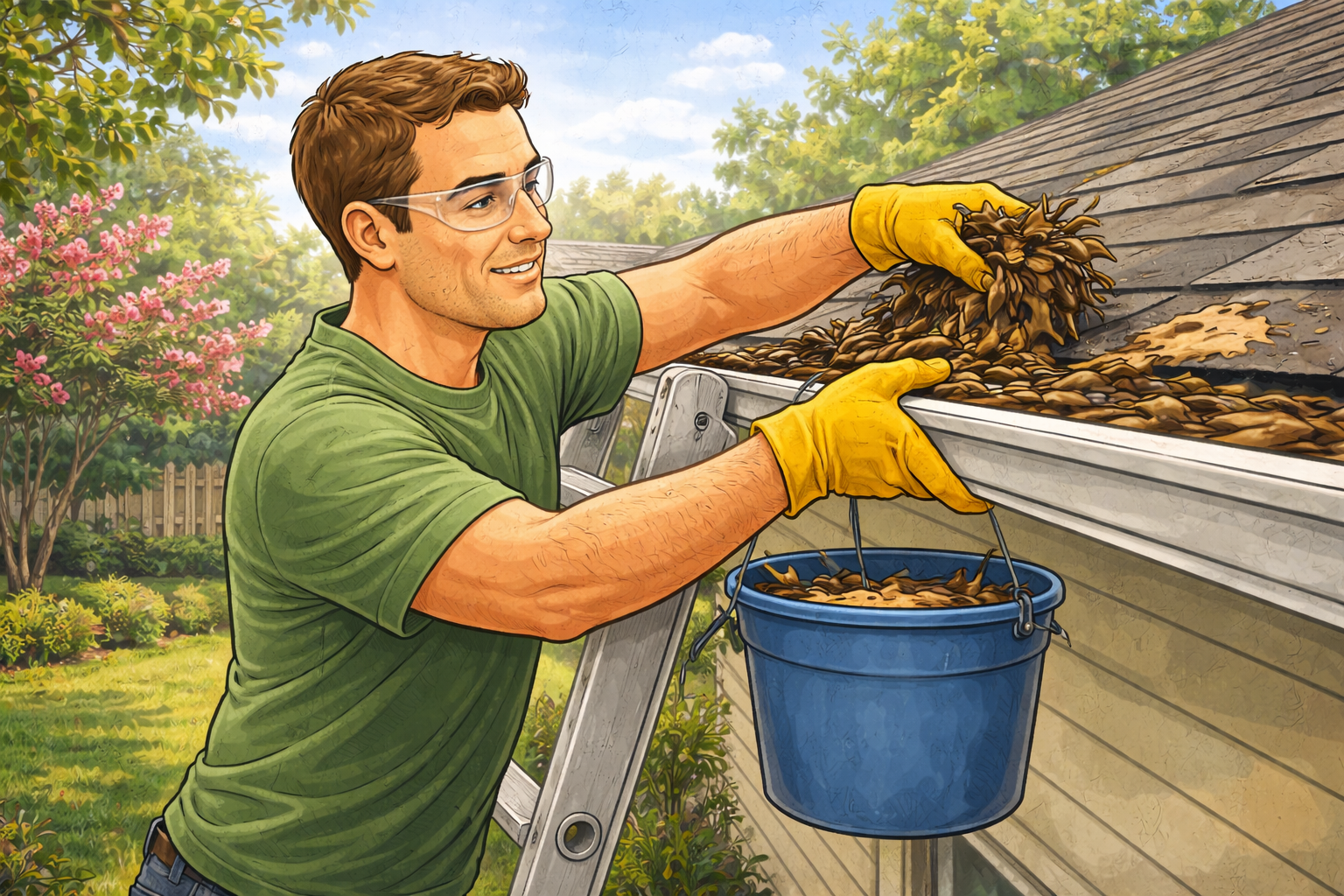
Do this before storms:
remove debris from gutters and downspouts
confirm downspouts discharge away from the foundation
during a rain, watch for overflow or water slipping behind the gutter
NRCA explicitly points homeowners to seasonal inspection/cleaning tasks like checking roof condition and cleaning gutters of debris. (National Roofing Contractors Association)
Step 4: Check valleys and roof-to-wall zones for debris dams
Valleys and roof-to-wall intersections collect leaves and granules. Debris can trap water long enough to push it into vulnerable details.
If you can’t clear it safely, don’t improvise. Schedule professional service.
Step 5: Use your attic as an early-warning system (if safely accessible)
Attic signals often show up before ceiling stains:
darkened roof decking
damp insulation
rust on nail tips/fasteners
musty odor
If moisture is present, the next step is correct diagnosis (leak vs. condensation), not guessing.
Step 6: Verify attic ventilation isn’t obviously compromised
Houston’s heat and humidity can amplify attic moisture and temperature issues.
Residential code provisions commonly establish minimum attic ventilation requirements using net free vent area ratios (often expressed as 1/150, with an allowance to reduce to 1/300 when specific conditions are met). (National Weather Service)
The practical homeowner takeaway: blocked intakes, crushed baffles, or disconnected vents can contribute to problems that look like roof trouble.
(If your home has a complex attic layout, ventilation performance should be evaluated as a system—intake + exhaust balance—rather than “add a vent and hope.”)
What NOT to do before spring storms
These are common “well-intended” moves that often create worse problems:
Don’t walk the roof unless you’re trained and equipped. It’s a fall hazard and can damage roofing materials. (National Roofing Contractors Association)
Don’t smear random caulk on shingles or flashing lines. Wrong sealants or wrong placement can trap water, crack, or create new paths.
Don’t ignore small symptoms like intermittent staining after specific wind directions—wind-driven rain is real in Gulf Coast storms.
When to schedule a professional inspection
A good rule for spring in Greater Houston:
Now (before storms become frequent) if your roof is 8–10+ years old, you’ve had prior leaks, or you see any red flags
After any significant wind/hail event if something looks different (or if the attic shows new moisture evidence)
NRCA’s homeowner guidance supports regular inspections as a way to catch issues like damaged shingles and flashing problems early. (National Roofing Contractors Association)
If a storm hits: the best first steps
Document what you can safely see (ground photos, attic photos if safe).
Avoid temporary “patches” that could complicate diagnosis or documentation.
Get a condition-based assessment before making irreversible decisions.
If insurance is part of your situation, this guide is a helpful next read:
https://communityroofingtexas.com/blog-1/dont-file-an-insurance-claim-after-a-storm-until-you-do-this-first
Ready for the simplest next step?
Free online roof estimate: https://communityroofingtexas.com/free-estimate
Inspection / roofing services: https://communityroofingtexas.com/roofing-services
Community Roofing Texas serves the Greater Houston area and helps homeowners identify vulnerabilities early—before spring storms turn small issues into expensive repairs.