
Roof Repair Tools, Materials, and Basic Roofing Terminology Homeowners Should Know
Before a homeowner tries to repair a roof, it helps to understand what the parts of the roof are actually called.
That may sound basic, but it matters. A lot of roof repair confusion starts with homeowners using one word to describe several different roof parts. Someone may say they have a “bad vent,” when the real issue is the pipe jack flashing. Someone may say a “shingle popped up,” when the problem is actually a lifted tab, a backed-out roofing nail, or wind damage. Someone may say the roof is “rotted,” when the visible issue may be damaged decking under one small area.
You do not need to become a roofer to understand your roof better. But if you know the basic roof repair tools, materials, and terminology, you can describe problems more clearly, take better photos, understand estimates more easily, and recognize when a repair is more complicated than it first appears.
That is especially important in Greater Houston, where asphalt shingle roofs deal with intense sun, high humidity, wind-driven rain, hail, tropical weather, and fast-moving storms. A small visible roof issue may not always tell the whole story.
Your Roof Is a System, Not Just Shingles
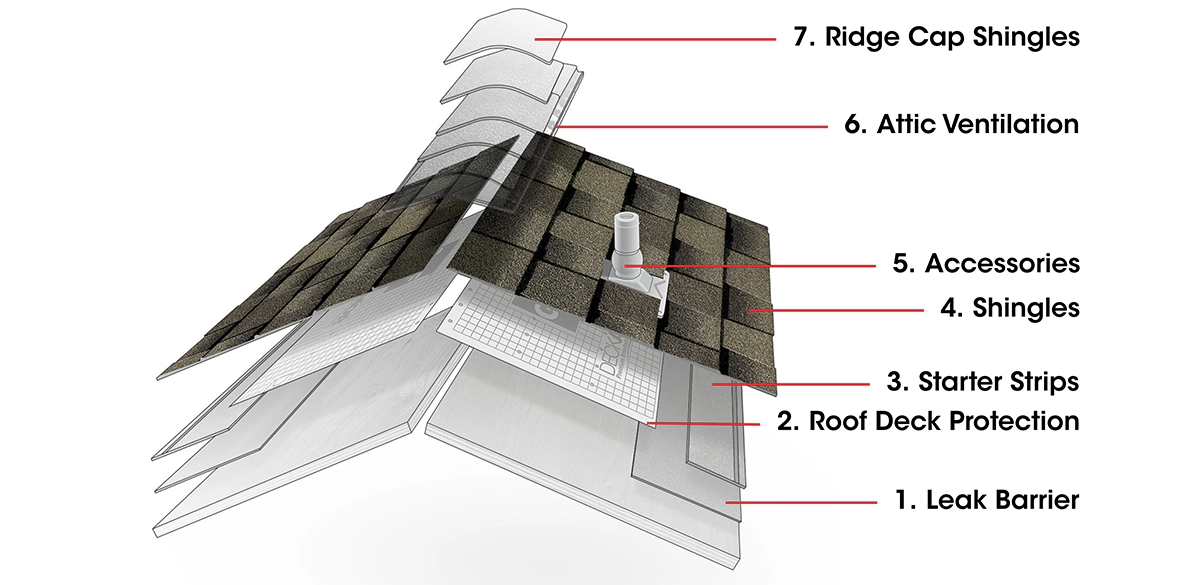
Most homeowners think of their roof as “the shingles.” That is understandable because shingles are the part you see from the ground. But a roof is a system made up of several components working together.
On a typical asphalt shingle roof, the system may include:
• roof decking
• underlayment
• shingles
• starter shingles
• hip and ridge shingles
• flashing
• pipe jacks or pipe boots
• vents
• drip edge
• nails and fasteners
• gutters and drainage components
GAF’s steep-slope roofing guide separates roofing into system components such as roof basics, decking, leak barriers, underlayment, ventilation, shingles, flashing systems, low-slope areas, and roof problems. The same guide also states that installers should follow current product instructions and local building codes, because codes vary by region.
When one part fails, the problem may show up somewhere else. For example, a ceiling stain inside the house may not be directly under the roof defect. Water can enter at a pipe jack, flashing transition, wall, or valley and then travel before it becomes visible inside the home.
This is why terminology matters. If you can identify whether the issue is near a valley, wall, chimney, pipe jack, roof vent, or roof edge, you are already in a better position to understand what may be happening.
Basic Roof Areas and Shapes Homeowners Should Know
Here are some of the most useful roof terms for describing where a problem is located.
Roof plane
A roof plane is one flat surface or section of the roof. A simple gable roof may have two main roof planes. More complex roofs may have several.
If you are taking photos or describing a repair, saying “the front left roof plane” or “the back slope over the garage” is more useful than saying “the roof.”
Slope or pitch
Roof slope describes how steep the roof is. In everyday roofing conversations, people often say pitch and slope interchangeably, using descriptions like 4:12, 6:12, or 12:12. Technically, GAF’s glossary defines roof pitch as the ratio of the rise of a roof to the span, which is the horizontal distance from eave to eave.
In practical homeowner language, the important point is simple: the steeper the roof, the harder and more dangerous it is to walk and work on.
Ridge
The ridge is the high horizontal line where two roof planes meet at the top. Many homes have ridge vents installed along this area for attic ventilation.
Hip
A hip is an outside angled line where two roof planes meet and slope downward. Hip roofs are common in many Houston-area neighborhoods.
Valley
A valley is the inside angle where two roof planes meet and water is directed downward. Valleys handle a lot of water, so they are important leak-prone areas. A problem in a valley is usually not the same as a simple missing shingle repair.
Eave
The eave is the lower roof edge, usually near the gutter. GAF defines eaves as the horizontal roof edge from the fascia to the structure’s outside wall.
Rake
The rake is the sloped edge of a gable roof. This is different from the eave. GAF defines the rake edge as the vertical edge of gable-style roof planes.
Gable
A gable roof has two peaked roof planes that meet at a ridge line. GAF defines a gable roof as a traditional roof style with two peaked roof planes meeting at a ridge line of equal size.
Basic Shingle Terms
Many Houston-area residential roof repair calls involve asphalt shingles. Even within that category, there are several terms worth knowing.
Asphalt shingle
An asphalt shingle is the roof covering material installed in overlapping rows. It is the visible outer layer on many residential roofs.
Architectural shingle
Architectural shingles are laminated shingles with a dimensional appearance. GAF defines laminated shingles as shingles made from two or more separate pieces laminated together, also called dimensional or architectural shingles.
3-tab shingle
A 3-tab shingle is a flatter asphalt shingle with a repeated tab pattern. Many older roofs still have them, while many newer roof replacements use architectural shingles.
Tab
The tab is the visible lower portion of a shingle. On 3-tab shingles, the tabs are obvious. On architectural shingles, homeowners may still casually refer to the visible sections as tabs, even though the design is different.
Course
A course is one horizontal row of shingles. Shingles are installed in overlapping courses so water sheds down the roof.
Exposure
Exposure is the part of the shingle left visible after the next course is installed. GAF defines exposure as the area of roofing material left exposed to the elements.
Seal strip or sealant strip
The seal strip is the adhesive strip that helps shingles bond together. GAF’s guide discusses self-sealing shingles and notes that cold weather, dirt, dust, and other conditions can delay or interfere with sealing.
In Houston, heat is not usually in short supply, but age, wind, dust, installation issues, or storm damage can still affect how shingles perform.
Granules
Granules are the gritty mineral surface on asphalt shingles. GAF defines granules as crushed rock with a ceramic coating used as the top surface of shingles and other roofing materials.
Granules help protect the asphalt portion of the shingle from sun exposure and weathering. Some granule loss is normal over time, but heavy or uneven granule loss can be a reason to take a closer look.
Starter shingle
Starter shingles are installed along roof edges before the main field shingles. GAF describes starter strip shingles as pre-cut shingles used at eaves and rakes with factory-applied adhesive strips to help prevent shingle blow-offs.
Hip and ridge cap
Hip and ridge cap shingles are installed over roof hips and ridges. GAF defines them as the final roof layer at the ridge or hip.
Nail line
The nail line, or nail guide line, is the area where roofing nails are supposed to be placed. GAF defines the nail guide line as a painted line on laminated shingles used to help with proper fastener placement.
Nail placement matters. High nails, overdriven nails, underdriven nails, or nails in the wrong location can create roof performance problems. GAF specifically notes that high nailing can cause blow-offs or allow shingles to slip, and that overdriven fasteners can damage shingles.
What Is Under the Shingles?
A roof problem may start at the surface, but the surface is not always the whole issue.
Roof decking or sheathing
Roof decking is the wood surface attached to the framing of the house. Shingles and underlayment are installed over the decking. GAF defines the deck as the substrate over which roofing is applied, usually plywood, OSB, wood boards, or planks.
If decking is soft, rotted, delaminated, or damaged, a surface repair may not be enough. You cannot properly secure roofing materials to bad decking.
Underlayment
Underlayment is the layer installed between the shingles and roof decking. GAF defines roof deck protection, also known as underlayment, as a water-shedding secondary layer of protection under the roof covering.
Underlayment is not meant to be the primary roof covering, but it is an important layer beneath the shingles.
Synthetic underlayment
Synthetic underlayment is a modern category of roof underlayment. Performance varies by product, so it is better to evaluate the specific material being used instead of assuming every synthetic underlayment performs the same way.
Felt underlayment
Felt is an older and still-recognized type of roofing underlayment. GAF defines felt as a flexible sheet manufactured through the interlocking of fibers with a binder or through mechanical work, moisture, and/or heat.
Ice and water shield / leak barrier
A leak barrier is a self-adhering underlayment used in vulnerable areas. GAF defines leak barriers as self-adhering underlayment protection against ice dams and wind-driven rain.
In Houston, the bigger concern is usually not ice dams. The more relevant concerns are heavy rain, wind-driven rain, roof transitions, valleys, penetrations, and storm exposure.
Flashing Terms Homeowners Should Know
Flashing is one of the most important roofing terms a homeowner can learn.
GAF defines flashing as components used to weatherproof or seal roof system edges at perimeters, penetrations, walls, expansion joints, valleys, drains, and other places where the roof covering is interrupted or terminated.
That matters because many roof leaks do not come from the middle of an open shingle field. They come from transitions.
Step flashing
Step flashing is used where a sloped roof meets a sidewall. It is installed in individual pieces with shingle courses. This is common along second-story walls, dormers, and some chimney sides.
Counter flashing
Counter flashing covers or protects base flashing. GAF defines counter flashing as metal or siding material installed over rooftop base flashing systems.
Apron flashing
Apron flashing is used at the front of a chimney or dormer. GAF defines apron flashing as metal flashing used at chimney or dormer fronts.
Headwall flashing
Headwall flashing is installed where the top of a roof slope meets a vertical wall. This is a common roof-to-wall transition.
Sidewall flashing
Sidewall flashing is used where the side of a roof slope runs along a vertical wall. Step flashing is commonly part of a sidewall flashing system.
Valley metal
Valley metal is metal flashing used in some valley systems. Not every valley is designed the same way. Some are open valleys with visible metal. Others are closed-cut or woven valleys where shingles cover the valley area.
Chimney flashing
Chimney flashing is not one single piece. It may include apron flashing, step flashing, counter flashing, backer flashing, or a cricket depending on the chimney and roof design. GAF defines a cricket as a peaked water diverter installed behind chimneys and other large roof projections.
Pipe Jacks, Vents, and Roof Penetrations
Anything that passes through the roof needs to be properly flashed.
Roof penetration
A penetration is anything that passes through the roof surface. GAF defines a roof penetration as anything such as pipes, conduits, HVAC supports, or solar supports passing through a roof.
Pipe jack / pipe boot
In the field, many roofers call the flashing assembly around a plumbing vent pipe a pipe jack. GAF uses the term pipe boot and defines it as a pre-flashed flashing unit for plumbing vent pipes or other round roof penetrations.
Homeowners may also hear this called a roof boot, vent boot, plumbing boot, or pipe flashing. The important point is that the flashing around the pipe is often the vulnerable part.
Plumbing vent
A plumbing vent pipe allows the plumbing system to vent through the roof. GAF defines plumbing vents as plumbing pipes that project through the roof plane, also called vent stacks.
The pipe itself is not usually the roof problem. The flashing around the pipe is what often needs attention.
Vent flashing
Vent flashing is the flashing around a roof vent or penetration. This term can apply broadly, but it is helpful when describing what part of the roof is involved.
Static vent
A static vent is a non-powered attic ventilation vent installed on the roof. Homeowners may call these turtle vents, box vents, roof vents, or air vents depending on the style.
Ridge vent
A ridge vent runs along the ridge of the roof and allows attic air to exhaust near the highest point.
Roof Edges, Gutters, and Drainage Terms
Some roof problems are really water-management problems.
Drip edge
Drip edge is metal installed at roof edges to help direct water away from the edge of the roof. GAF defines drip edge as a non-corrosive metal lip that keeps shingles up off the deck at roof edges, extends shingles over eaves and rakes, and allows water to drip clear of underlying construction.
Fascia
Fascia is the vertical board behind the gutter at the eave. If gutters overflow or roof edges are not shedding water properly, fascia can become damaged over time.
Soffit
The soffit is the underside area below the roof overhang. Many homes have soffit vents that help provide attic intake ventilation.
Gutter
The gutter collects water at the eave and carries it to downspouts. A clogged or sagging gutter can cause water to back up or spill where it should not.
Downspout
The downspout carries water from the gutter down to the ground. If downspouts discharge too close to the foundation or into a bad drainage area, the issue may extend beyond the roof.
Common Roof Repair Tools Homeowners Hear About
This is not a recommendation that every homeowner should buy roofing tools or attempt roof repairs. It is simply helpful to know what these tools are.
Inspection and documentation tools
For most homeowners, the safest tools are the ones used from the ground or inside the attic.
Useful documentation tools include:
• phone camera
• binoculars
• flashlight
• tape measure
• notepad
• drone, if it can be used safely without getting on the roof
Good photos are often more valuable than a risky climb onto the roof.
Basic roofing hand tools
Roofers commonly use tools such as:
• hammer
• flat bar
• roofing shovel or tear-off tool
• utility knife
• tin snips
• caulk gun
• measuring tape
• chalk line
A flat bar may be used to lift shingles or remove nails, but this is also where homeowners can accidentally damage brittle shingles. A caulk gun may seem simple, but putting sealant in the wrong place can trap water, hide the real issue, or make the later repair harder.
Tools that require more caution
Some tools raise the risk level quickly:
• extension ladders
• roofing nailers
• compressors
• circular saws
• harness and rope systems
• roof jacks and planks
The important point is simple: owning the tool does not mean the repair is safe. A roofing nailer can install nails quickly, but it can also install them incorrectly very quickly.
Common Roof Repair Materials and What They Are Used For
Roof repair materials should match the actual problem. This is where many DIY repairs go wrong.
Replacement shingles
Replacement shingles are used when a damaged shingle can be removed and replaced without damaging the surrounding roof. The challenge is matching the shingle type, color, age, size, and condition. On an older roof, the surrounding shingles may be too brittle to lift safely.
Roofing nails
Roofing nails are used to fasten shingles and accessories. Nail type, length, placement, and drive depth matter. Underdriven nails can hold shingles up. Overdriven nails can cut into or through the shingle. GAF notes that underdriven nails can force shingles to buckle or lift into the wind, while overdriven fasteners can damage shingles.
Roofing cement
Roofing cement is a thick asphalt-based material used in certain roofing applications and temporary repairs. Homeowners often call it “tar,” but that is not always accurate.
GAF defines asphalt plastic cement as a solvent-based asphalt sealant used for hand-sealing shingles and sealing other locations on asphalt roofs.
Roofing cement can be useful, but it is often overused. Smearing roofing cement over a leak without understanding the actual water path may only create a mess and make the later repair harder.
Polyurethane sealant
Polyurethane sealant can be part of certain roofing details when used correctly and in the right location. For example, GAF’s chimney counter flashing instructions reference sealing a joint with plastic roof cement or polyurethane sealant.
The problem is not sealant itself. The problem is relying on sealant to solve a flashing, shingle, decking, or drainage issue that requires a different repair.
Roof sealant
“Roof sealant” is a broad term. Different products are made for different materials and conditions. A product that works on one roof component may not be appropriate for another.
Always read the product label and understand the limitation of the material before using it.
Pipe jack boot / pipe boot
The pipe boot is the flexible or pre-flashed component around a plumbing vent pipe. Some repair products are made to go over an existing boot, while full replacement involves changing the flashing assembly.
Vent flashing
Vent flashing is used around a roof vent or penetration. Replacing it may require disturbing shingles around it.
Tarp
A tarp is a temporary emergency measure, not a permanent roof repair. A tarp can help reduce active water entry until the roof can be inspected and repaired properly.
Roofing Measurements and Estimate Terms
A few measurement terms can help homeowners understand roofing estimates.
Square
A roofing square equals 100 square feet of roof area. GAF explains that a roofing square is a 10-foot by 10-foot area of roof, totaling 100 square feet. (GAF)
This is not the same as the square footage of the house. A 2,000-square-foot house may have more than 2,000 square feet of roof area because of pitch, overhangs, garages, porches, and roof complexity.
Bundle
A bundle is how shingles are packaged by the manufacturer. The number of bundles needed per square depends on the shingle product. GAF explains that bundles are manufacturer packaging and that the bundle count needed depends on roof measurements and the specific shingle. (GAF)
Linear foot
Linear foot measures length. Gutters, ridge vents, drip edge, valleys, and flashing are often discussed in linear feet.
Tear-off
Tear-off means removing the existing roof covering before installing new materials. This allows the roof deck, flashing, and hidden conditions to be inspected.
Overlay or recover
A recover means installing an additional roof covering over a prepared existing roof covering without removing the existing roof covering. GAF defines re-cover this way.
Whether a recover is allowed or advisable depends on the existing roof, product instructions, local requirements, and roof condition.
Waste factor
Waste factor accounts for extra material needed because of cuts, valleys, hips, ridges, layout, and roof complexity. GAF notes that roof complexity, rakes, valleys, eaves, overhangs, dormers, and pitch can affect shingle waste and estimating. (GAF)
Low-Slope Roof
Many homeowners call these “flat roofs,” but that is not always accurate.
A low-slope roof has less slope than a typical steep-slope shingle roof. GAF states that shingle roof pitches less than 4:12 are considered low-sloped, that special installation practices must be used from 2:12 up to 4:12, and that shingles cannot be installed at slopes less than 2:12.
This matters because a roof area that looks like a normal shingle repair may actually need a different roofing material or installation method if the slope is too low.
Terms Homeowners Commonly Misuse or Confuse
Some roofing terms get used loosely. That can create confusion.
“Vent boot” vs. “pipe jack”
Many homeowners say “vent boot.” Many roofers say “pipe jack.” Some manufacturer literature uses “pipe boot.” For practical homeowner communication, all of these usually refer to the flashing assembly around a plumbing vent pipe.
“Tar” vs. roofing cement or sealant
Homeowners often call any black roof repair material “tar.” The actual material may be roofing cement, asphalt plastic cement, polyurethane sealant, or another product.
“Leak” vs. “stain”
A ceiling stain may be evidence of a leak, but it does not always mean the roof is actively leaking at that moment. The stain may be old, intermittent, or connected to another issue.
“Missing shingle” vs. lifted, creased, slipped, or torn shingle
A missing shingle is different from a lifted shingle, creased shingle, slipped shingle, or torn shingle. Those differences matter because they point to different causes and repair options.
“Rotten roof” vs. damaged decking
A homeowner may say the roof is rotten when they see soft wood, staining, or interior damage. More specifically, the issue may be damaged decking, fascia, framing, or another wood component.
“Nail pop”
In home repair language, “nail pop” often means an interior drywall nail or screw pushing through the wall or ceiling surface. In roofing, it is clearer to say “backed-out roofing nail” when a roofing nail has lifted or worked upward on the roof surface.
GAF uses “nail-pop” to describe a roofing nail that is not fully driven or backs out of the roof deck, which can raise overlying shingles or allow nail heads to break through overlying shingles.
That distinction matters because an interior drywall nail pop and a backed-out roofing nail are completely different issues.
What Homeowners Should Not Assume From Roofing Terms Alone
Knowing the name of a roof part is useful, but it does not prove the cause of the problem.
For example:
• A cracked pipe boot may not be the only source of a ceiling stain.
• A missing shingle may have exposed underlayment or decking.
• A lifted shingle may be caused by wind, poor fastening, age, or installation issues.
• A valley leak may involve shingles, underlayment, valley metal, debris, or roof geometry.
• A wall leak may involve siding, flashing, windows, brick, or roof-to-wall transitions.
This is why roof repair can be frustrating for homeowners. The visible defect is important, but water does not always travel in a straight line from the roof surface to the ceiling stain.
In Houston, wind-driven rain makes this even trickier. A roof may not leak during a normal rain but may leak when wind pushes water into a vulnerable transition.
When to Stop and Call a Roofer
Some roof issues are reasonable to observe, document, and understand. Others are not good DIY candidates.
Stop and call a roofer if:
• the roof is steep, wet, high, or difficult to access
• shingles crack or break when lifted
• the problem is near a valley, chimney, skylight, wall, or roof transition
• decking feels soft or looks damaged
• water is actively entering the home
• you are not sure where the water is coming from
• the repair depends entirely on smearing sealant over an unknown issue
• the damage may be from wind, hail, or falling debris
• you need documentation for an insurance claim
• the repair requires removing several surrounding shingles
A lot of roof damage gets worse when someone tries to “just patch it real quick” without understanding the system. The goal is not to scare homeowners away from learning. The goal is to help you know the difference between understanding a problem and safely repairing it.
Bottom Line
Homeowners do not need to know every roofing term. But learning the basic roof repair tools, materials, and terminology can help you make better decisions.
If you can describe the roof plane, identify whether the problem is near a valley or penetration, understand the difference between shingles and flashing, and recognize when sealant is only part of the answer, you are already ahead of most homeowners.
The biggest takeaway is this: a roof is a system. Shingles, flashing, underlayment, decking, ventilation, fasteners, and drainage all work together. A small visible defect may be simple, or it may be a clue to something more involved.
If you are in the Greater Houston area and are not sure what part of your roof you are looking at, Community Roofing Texas can help inspect the issue, explain what is happening, and walk you through practical repair options without turning it into a sales pitch.