
Roof Safety: What Every Homeowner Needs to Know Before Getting on a Roof
Most homeowners understand that roof work can be dangerous. But many people still underestimate just how quickly a simple roof repair can become risky once you add height, slope, heat, tools, loose granules, wind, and changing weather.
Roof work is not like fixing a fence board, patching drywall, or replacing a sink faucet. On a roof, every movement matters. A small slip, a careless step backward, or an overloaded ladder climb can turn into a serious fall before you have time to react.
This does not mean every homeowner is helpless when something goes wrong with the roof. But it does mean roof safety needs to come first.
Before climbing onto a roof to inspect a leak, seal a small opening, replace a shingle, or perform any temporary repair, you need to understand the risks and how to reduce them.
Roof Safety Starts Before the Ladder Goes Up
The first safety decision happens before you ever touch the ladder.
Start with the roof itself. How steep is it? Some roofs are low-slope and relatively walkable. Others may look manageable from the ground but feel completely different once you are standing on them.
Roof pitch changes everything. The steeper the roof, the less room there is for error. A roof that feels only slightly uncomfortable at first can become much more dangerous once you are holding tools, reaching, kneeling, or trying to maneuver around vents and other roof penetrations.
Surface conditions matter too. Asphalt shingles can be slippery when wet, dusty, covered in loose granules, or coated with morning dew. In Houston, humidity alone can leave a roof surface slick early in the day, even when it has not rained.
Wind is another factor homeowners often underestimate. The breeze is stronger when you are higher up and exposed to unobstructed, straight-line wind. A light breeze on the ground can feel very different on a roof.
Small items like a tube of sealant or a small piece of flashing are not the issue. The bigger concern is anything heavy or awkward enough to throw off your balance, like a bundle of shingles, or anything that can catch wind, like a tarp. A tarp can turn into a sail very quickly when you are standing on a roof.
Heat matters too. Shingles can get extremely hot under direct Texas sun. That heat can make the surface uncomfortable to kneel on, hard to touch with bare hands, and physically draining after only a short time.
Good roof conditions are boring: dry surface, calm weather, full daylight, manageable temperature, and a roof slope you can move on safely.
If any of those conditions are not right, the safer choice is to wait.
Ladder Safety Is One of the Biggest Parts of Roof Safety
Many roof accidents happen before the repair even starts. The ladder-to-roof transition is one of the most dangerous moments of the entire job.
Use a ladder that is tall enough for the roof edge. OSHA’s construction ladder standard says that when a portable ladder is used to access an upper landing surface, the ladder side rails should extend at least 3 feet above the upper landing surface. OSHA also describes the proper angle for a non-self-supporting ladder as placing the base about one-quarter of the ladder’s working length away from the top support. In simple terms, that is the common 4-to-1 ladder angle rule: for every 4 feet of ladder height, the base should be about 1 foot away from the wall or roof edge.
The ladder should be set on firm, level ground. OSHA also says ladders should be used on stable and level surfaces unless secured to prevent displacement, and that they should not be loaded beyond the manufacturer’s rated capacity.
Here is a practical roofer trick homeowners may find useful: we often place a heavy shingle bundle at the base of the ladder to help reduce the chance of the ladder base slipping out. That does not replace correct ladder angle, stable ground, proper ladder feet, or common sense, but it is an added layer of protection.
Keep your body centered between the ladder rails. Face the ladder while climbing. Move slowly. Maintain three points of contact whenever possible, meaning two hands and one foot, or two feet and one hand.
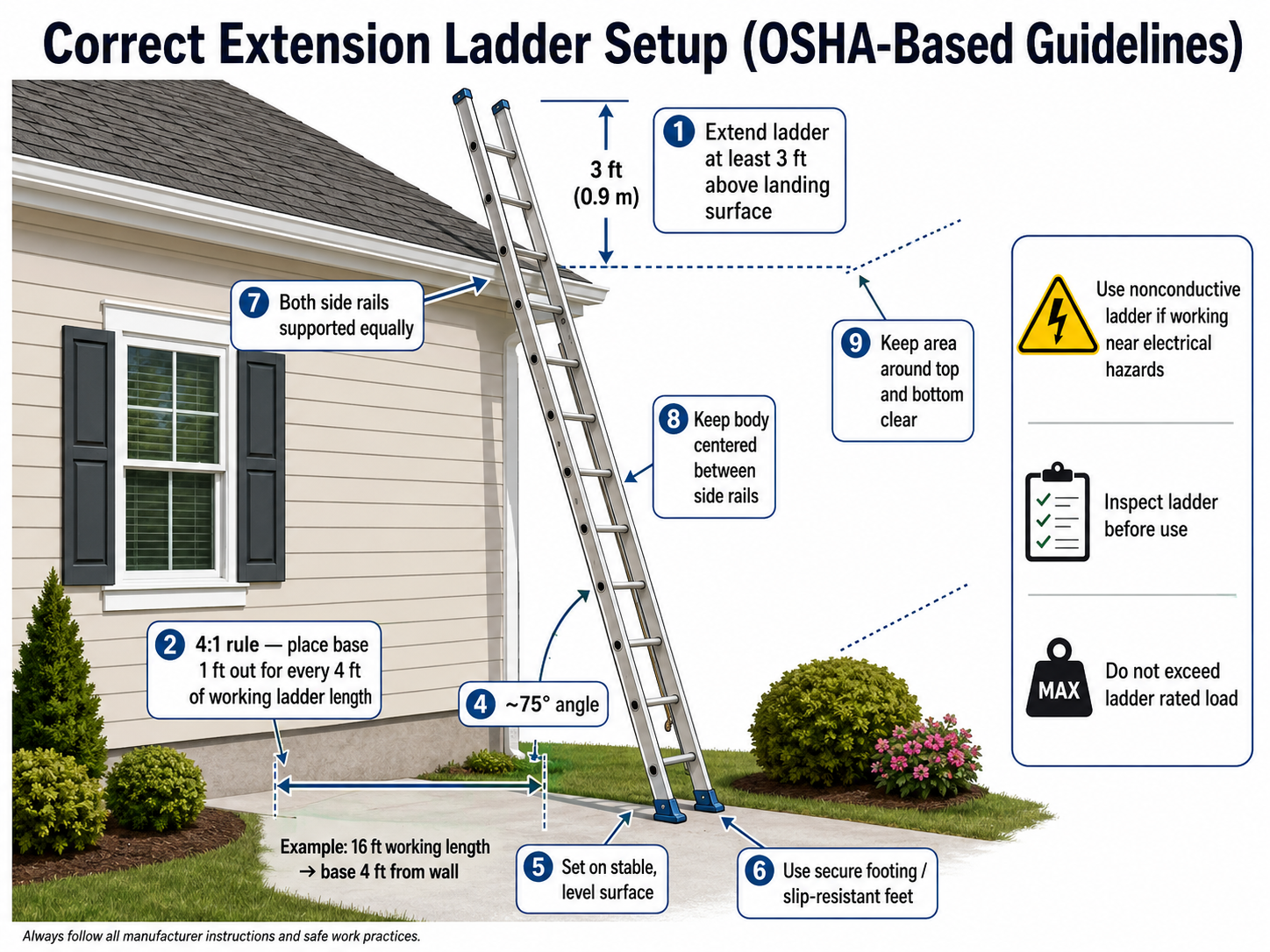
Correct Extension Ladder Setup (OSHA-Based Guidelines)
A common piece of ladder advice is not to carry tools or materials in your hands while climbing. That advice is correct in principle, but it needs practical context.
The answer is not to overload yourself, and it is also not automatically to pull a bucket of tools up by rope while standing near the roof edge. On a steep roof, pulling a swinging bucket or heavy load up and around the eave can create a new hazard. It can force you to stand too close to the edge, reach outward, twist your body, and manage weight while your footing is already compromised.
A better rule is this:
Do not try to get everything onto the roof in one trip.
Several small, controlled trips are safer than one overloaded climb. Small tools can go in a tool belt, pouch, or secured bag that keeps your hands free. Small materials should only be carried if they are secured and do not affect your balance. Bulky or awkward materials should be avoided unless there is a safe, controlled way to stage them.
The goal is not to be efficient. The goal is for every trip up and down the ladder to be boring, stable, and uneventful.
Wear the Right Shoes, Gloves, and Sun Protection
Footwear matters more than many homeowners realize.
A roof is not a hiking trail. Hiking boots are designed to dig into dirt, gravel, and uneven ground. Rock climbing relies on handholds, friction, leverage, and interacting with the climbing surface.
Roof work is different.
On a shingle roof, you are trying to maintain traction without damaging the roof surface. Aggressive lug soles can scuff shingles, dislodge granules, or catch in awkward ways. Roofers often wear soft-soled shoes or specialized roofing footwear designed to grip shingles without tearing them up.
Cougar Paws are a good example of why roof footwear is different. They are roofing boots made for roof surfaces, and some models use replaceable traction pads that attach to the boot sole. The point is not that every homeowner needs to buy a pair. The point is that professional roof traction is more about soft, controlled grip than digging into the surface like a hiking boot. Cougar Paws describes its roof footwear as designed for different roof surfaces and notes that its boot soles use industrial Velcro with replaceable pads.
Avoid sandals, slick soles, worn-out shoes, muddy shoes, or heavy boots with aggressive tread. Your shoes should grip well, flex naturally, and allow you to feel the surface under your feet.
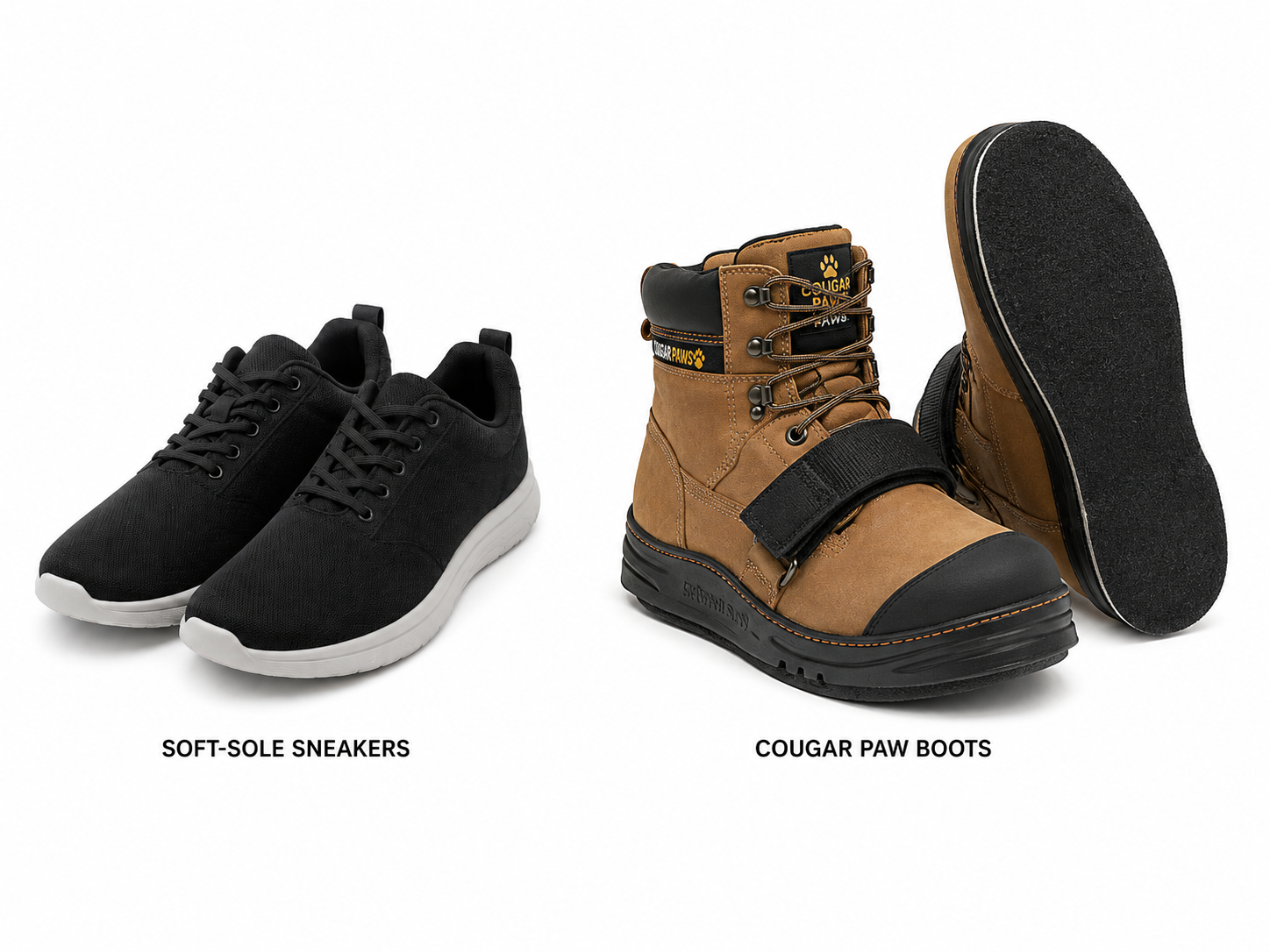
Soft sole shoes are your best bet
Gloves are also important. They protect your hands from abrasion, sharp metal, rough shingles, exposed fasteners, and heat.
This matters because if you slip or end up in a precarious position, you may need your hands for stability. Discovering that the roof is too hot to touch when you need an extra point of contact is a bad situation.
On bright days, bring sunglasses. Glare off shingles, flashing, vents, and white trim can make it uncomfortable to see clearly.
If you will be on the roof more than a few minutes, wear sun protection. Long sleeves may seem counterintuitive in the heat, but sweat is unavoidable; sun exposure is avoidable. A sun hat or neck protection can also help, as long as it does not interfere with your visibility or movement.
Move Differently on a Roof
Once you are on the roof, slow down.
Move deliberately. Keep your center of gravity low. Avoid sudden turns. Do not rush from one area to another. Every step should be intentional.
One of the most important habits is avoiding backward steps.
Most people do not plan to walk backward on a roof, but during a repair it happens naturally. You finish applying sealant, adjust your position, back up to look at your work, or take a step back to grab a tool.
That is where trouble starts.
If you step backward into a pipe jack, vent, ridge, raised shingle, tool, or piece of debris, a small stumble can become a major fall. On the ground, tripping over something behind you may be embarrassing. On a roof, it can be dangerous.
If you need to move, turn and look first. Know exactly what is behind you before shifting your weight.
Also avoid stepping on roof components unless necessary. Pipe jacks, vents, skylights, ridge vents, flashing, and roof-to-wall areas can all create trip points, slick surfaces, awkward footing, or damage risk.
A pipe jack may not look like much, but catching your heel on it while moving sideways or backward can be enough to throw you off balance.
Use the Roof Layout to Your Advantage
When possible, position yourself so there is something downhill of you.
A chimney, ridge, pipe jack, valley, dormer wall, or roof transition is not a substitute for fall protection. But these roof features can provide an added layer of protection because they may help stop or slow you if you slip.
If you have a completely open slide path from your feet to the eave, a slip has fewer chances to slow down before the roof edge.
When possible, work in areas where the roof shape gives you some kind of interruption downhill, such as:
• a lower-level ridge
• a chimney
• a dormer wall
• a valley
• a roof-to-roof transition
• pipe jacks or other roof penetrations
Those features should not give you a false sense of security, and you should not intentionally rely on them as your only safety plan. But if you do slip, you would much rather have something downhill that may help stop you than a clean, uninterrupted path to the eave.
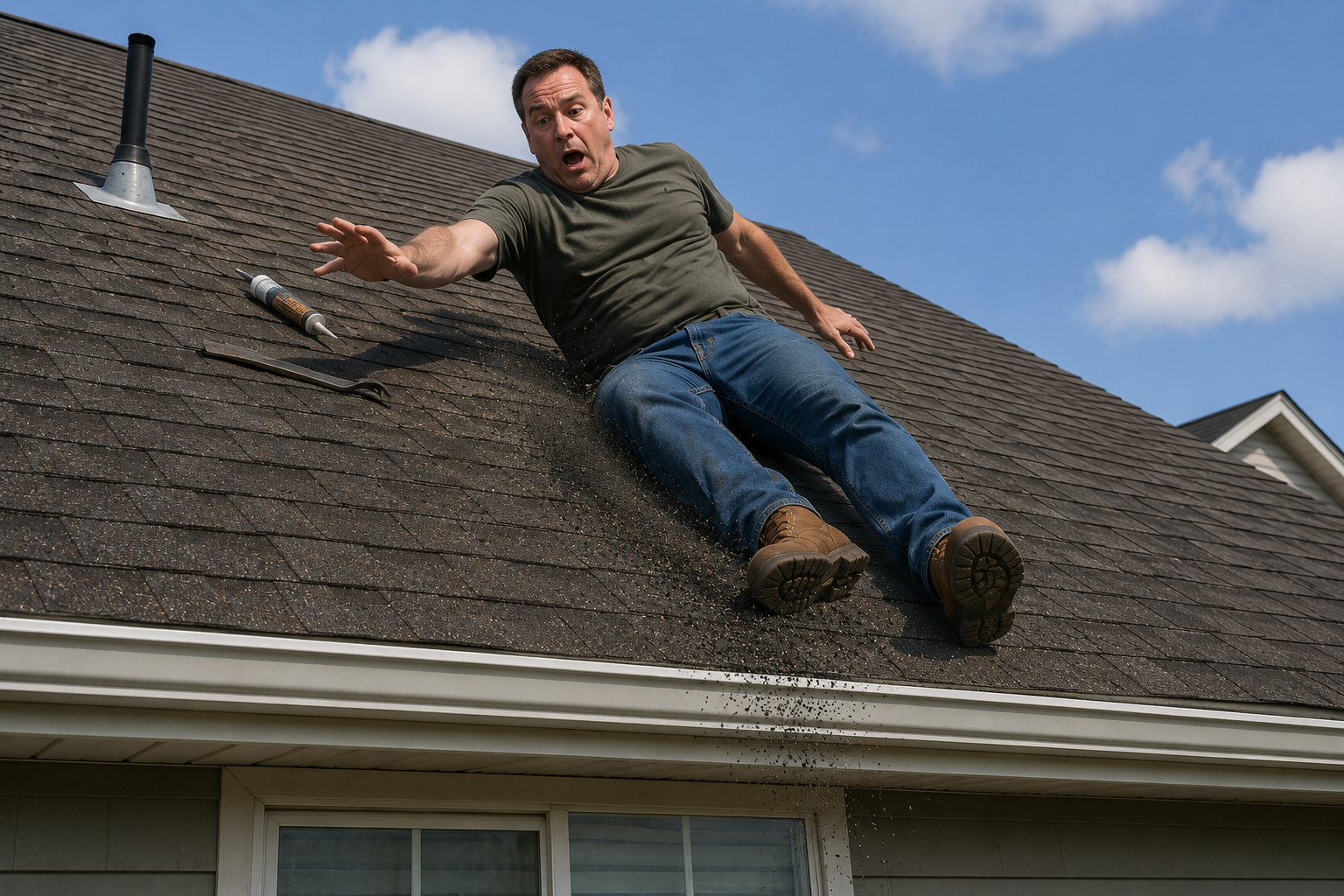
Hips and ridges can also help with controlled movement. Traversing near a hip or ridge may give your hands a reference point or something to grab if your footing feels uncertain.
That does not mean you should pull on fragile materials or damage ridge components. It simply means the shape of the roof can help you move more intelligently.
Avoid working directly above an open eave when another safer position is available.
Be Careful Around Roof Edges and Obstacles
The roof edge is the highest-risk area.
The closer you are to the eave or rake edge, the less room you have to recover from a slip. Repairs near roof edges require extra caution.
If a repair is needed near the edge, ask yourself whether it can be done from a properly placed ladder instead of setting up shop on the roof. Sometimes the safer position is not on the roof at all. A well-placed ladder may allow you to reach a small edge repair while keeping your body better controlled and avoiding a risky roof position.
If you find yourself leaning, reaching, or stretching to work near the edge, stop and reposition.
Valleys also deserve caution. They can collect granules, leaves, pine needles, moisture, and debris. Metal valley surfaces can be slick. Roof-to-wall areas can force awkward body positioning. Skylights should never be stepped on.
Pipe jacks, vent flashings, exhaust vents, satellite mounts, solar attachments, and other roof penetrations are not just things you might damage. They are also safety hazards because they interrupt your path of travel. They can catch your foot, change your stride, or force you into awkward movement on a slope.
Keep your walking path clear.
Tools, wrappers, nails, cut shingles, sealant tubes, pry bars, and loose debris should never be left where you may step. On a roof, clutter is not just messy. It is a slip or trip hazard.
Heat Can Become a Safety Problem Fast
Houston roof work can become physically draining quickly.
Shingles absorb heat. Attic heat radiates upward through the roof deck. Direct sun beats down from above. Even a short repair can feel much harder than expected once you are on the roof.
I will admit, I have made this mistake myself a few times. It is hot, I am working on a roof or in an attic, and I get impatient. I just want to finish the job and get it over with. So I push harder than I should. A few times, I pushed myself too far and did not feel right for several days afterward.
That is not just uncomfortable. It is dangerous.
Heat stress can affect your judgment, your balance, your reaction time, and your health. Depending on your age, hydration, medications, conditioning, and any underlying health conditions, overheating can become serious or even fatal.
Take breaks before you are exhausted. Drink water. Do not push through dizziness, lightheadedness, shaky legs, nausea, confusion, or frustration.
A tired, overheated person on a roof is more likely to rush, misstep, or make a bad decision.
One practical trick is to bring an old couch cushion or thick pad. A couch cushion is not just for comfort. On a shingle roof, it can give you an incredible amount of traction and stability while kneeling or sitting. It also protects your knees, hands, and forearms from hot shingles.
For small repairs, a cushion can be an invaluable addition to your roofing toolset.
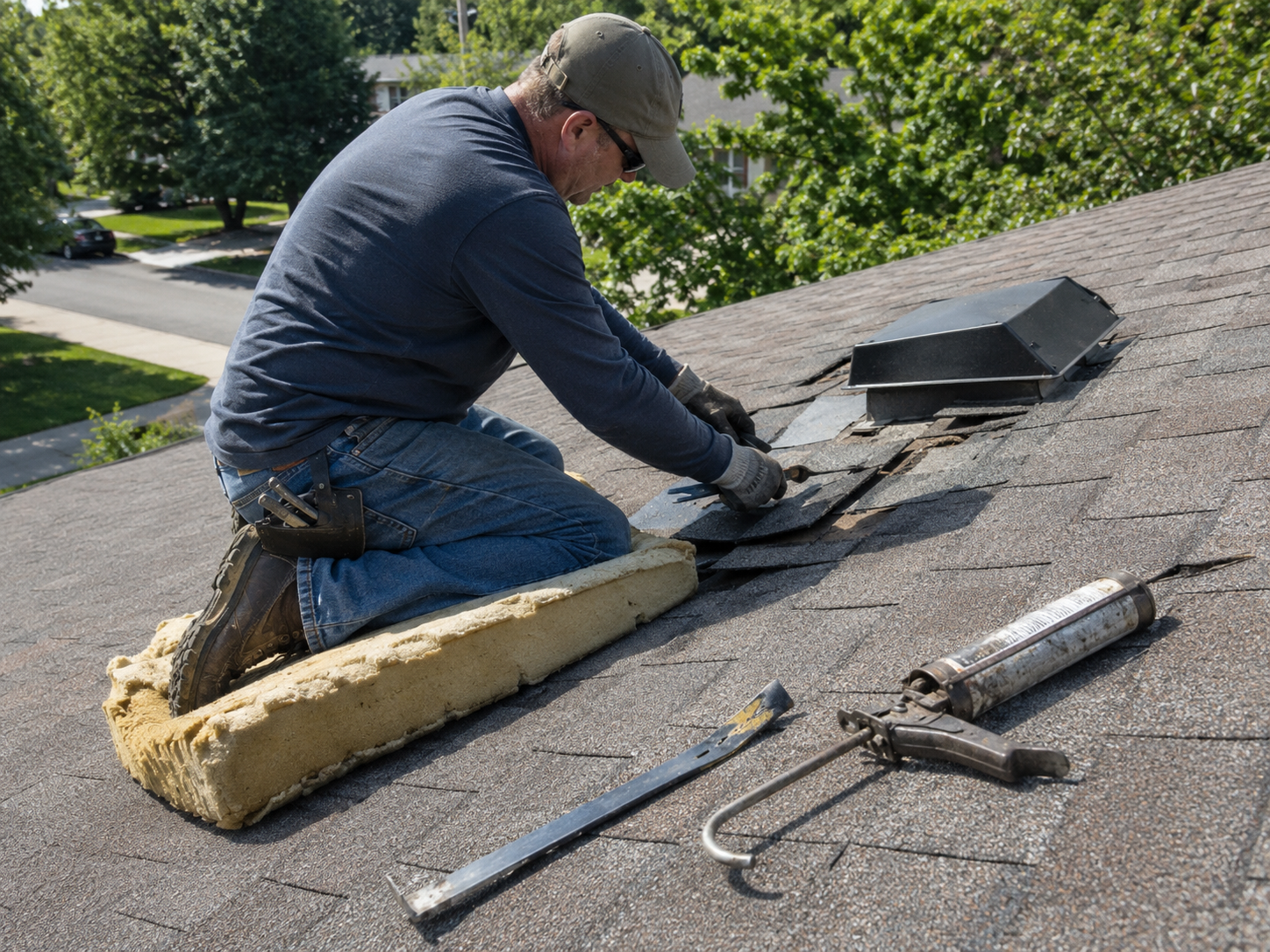
Just use it intelligently. Do not place it where it will block your path, or interfere with your footing. It helps with traction, comfort, and heat protection, but it is still not a replacement for careful positioning and good judgment.
Stay Away From Electrical Hazards
Electrical service equipment near the roof should be treated seriously.
Stay away from overhead power lines, service drops, weatherheads, and meter masts. Do not work near a meter mast unless you know exactly what you are doing.
The metal mast and the wires around it are not something to casually lean against, grab, inspect, seal, or work around. Utility guidance commonly warns that incoming power components and electric meter equipment should be treated with caution, and that incoming power can be deadly.
Avoid using metal ladders near electrical hazards. Before placing a ladder, look up and around the work area. If the repair area is close to overhead electrical service, that is usually not a homeowner-level roof repair.
Water and electricity make the risk worse. If there is storm damage, wet equipment, damaged service components, or anything questionable around the electrical connection, stay away and call the appropriate professional.
Work With Another Person When Possible
Roof work should not be done alone if you can avoid it.
A second person can stabilize the ladder, hand up small items once you are safely positioned, watch the area below, and call for help if something goes wrong.
They can also help keep children, pets, and bystanders away from the work area.
Communication matters. Do not move ladders, toss tools, shift materials, or change work areas without making sure the other person knows what is happening.
The person on the ground should also avoid standing directly below the work area. Tools and materials can slide or fall unexpectedly.
Know When to STOP
One of the most important roof safety skills is knowing when to stop.
STOP if the roof feels steeper than expected.
STOP if the ladder feels unstable.
STOP if the shingles are wet, slick, brittle, curled, loose, or crumbling.
STOP if the decking feels soft or spongy under your feet.
STOP if the wind picks up.
STOP if you find yourself needing to work too close to the edge.
STOP if the repair may be safer from a ladder than from the roof surface.
STOP if the repair requires more force than expected. Prying, lifting, pulling, or fighting with materials can throw off your balance. A repair that seemed simple from the ground may become very different once you are on the roof.
STOP if tools, debris, or materials are cluttering your path of travel.
STOP if you are near overhead power lines, service wires, a weatherhead, or a meter mast.
STOP if you feel rushed, overheated, nervous, or unsure.
There is no roof repair worth a serious fall.
The Bottom Line
Roof safety is not about one piece of equipment or one rule. It is about the entire situation: weather, ladder setup, roof pitch, footwear, heat, body position, tools, materials, obstacles, and judgment.
If you do get on a roof, move slowly. Keep your path clear. Avoid backward steps. Stay away from electrical service equipment. Do not overload yourself on the ladder. Use several small, controlled trips instead of trying to carry everything at once. Wear the right shoes, gloves, sunglasses, and sun protection.
Most importantly, know your stop point.
A roof repair is only successful if it solves the problem without causing an injury, creating more roof damage, or turning a manageable issue into an emergency.
Community Roofing Texas helps Houston homeowners evaluate roof problems, leaks, storm damage, and repair options safely. If a roof issue feels too steep, too risky, or too uncertain to handle on your own, it is better to have it inspected before the problem gets worse.